Saturday, March 31, 2012

TEDx - the energy you give


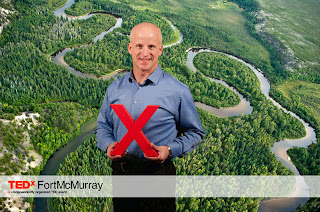
Pacing backstage in the moments leading up to my TEDxFortMcMurray presentation, I was doing everything I could think of to get my emotions in check.  "Breathing. Breathing. Breathing," I texted my wife who was out of town on a course and unable to attend the inaugural inspiring speakers event in our community.

I shared my excitement and shaky demeanor on Facebook and messages of support began appearing from friends and family, near and far, assuring me that it was going to be great - each message another release valve for the well of feeling that was bubbling up inside of me waiting to get out.

When David Sabine came off the stage after his presentation, he effused that "it was so much fun."  He added that the audience was extremely responsive.  Hearing those words emboldened me and prompted somewhat of a reset in terms of how I was preparing.

I began moving away from thinking of the stage and the experience as me making a presentation to them, toward me making a presentation with them.  Much like my social media timeline, success or failure would be defined by my ability to include the audience as part of the story.  It was a fundamental shift in thinking, and while my script lent itself to audience connectivity, it hadn't settled into my core until I was stage left leaning against the grand piano in the dark, feasting on the energy being shared on the stage by my dear friend Julie Funk, presenting on her powerful love for Fort McMurray.

With less than a minute left before emcee Matt Youens would invite me on the stage, I began toying with a slight variant to how I was going to open.  All along, it was going to be a simple "Good morning," followed by the question about the artist who painted the piece in my opening slide.


The video of what actually happened may prove otherwise, but I think "Good morning," became "Good morning friends," followed by "Facebook friends," and "How many people are on my Facebook?" - at which point a majority of hands in the audience shot up - followed by "Twitterites" - as a healthy number of hands once again reached for the heavens.  The ice had been broken, my nerves released into the earth.

As I moved through the story, from how much has changed since 1975 to watershed moments and beyond into my discovery of Facebook, it was great to make eye contact with people I knew in the audience - just enough house lights were up to make those visual connections possible (thank you!).

I felt great as I dived into the Dylan Surgery Adventures, describing the genesis of my social media writing journey, and very personal Facebook notes that chronicled two weeks in the fall of 2008 when my oldest son had a major leg operation in Edmonton.  I was a blubbering fool after recounting the tale in episode 4 when after helping clean him up after he "worked things out" on a wheelchair commode he asked for a hug and said "thank you for helping today."  Based on what I heard at the break, I wasn't the only one having a hard time holding it together; mothers and fathers alike made a very personal connection to that moment.

"Did I make you cry?" I asked Mayor Blake jokingly during the lunch intermission.

"You know the amazing thing is that I remember reading that story," she shared.

It's an incredible compliment when someone remembers something I wrote last week, let alone something I posted almost four years ago.


Another person came up and shared the fact that he had heard about the day when I went to work sporting two different pairs of shoes.  His wife had done the exact same thing the day before I did.  I guess at the end of the day we're all human, and there is something very compelling about having the courage to admit that truism.

The other resonant thought that occurred as we enjoyed a full day of ideas worth sharing, is that we all have a story that deserves to be told and heard.  TEDxFortMcMurray provided a brilliant forum for beginning that process of unearthing stories that matter, stories that deserve to be out there in the world via the power of the Internet and YouTube.

Each presenter, each in their own way, rose to the moment and delivered the talk of their lives.  Congratulations to Malik Badar Aman (On Chasing Dreams), Anas Eljamal (Controlling Instincts), Sheldon Germain (Pathway to Potential-A New Understanding), David Sabine (Rethinking Education), Julie Funk (Loving Fort McMurray), Mark Elliott (Life in a Learning Community - Learning, Unlearning and Relearning Fort McMurray), Kevin Scoble (Waste as Resource), Reinalie Jorolan (Uncompromising Commitment to Self, Motherhood and Community), Maria Fustic (Reaching the Summit) and Tim Reid (Third Down Leadership).


I can't say enough about the people behind the scenes who put this incredible event together.  As a Leadership Wood Buffalo case study project, it provided a wealth of learning and an abundance of community impact.  You should all be very proud of the results: Gaurav Gupta, Jude Groves, Karen Puga, Matt Youens, and Michelle Landsiedel.  A big thanks to Renee Summers, Ken Chapman and Loraine Humphrey who contributed as part of the organizing committee, and to all the volunteers and sponsors who gave their valuable time and support.

The next step for all of us is to share these presentations when they are released on video in the next couple of weeks.  Together we can leverage the power of these transformative ideas and compelling stories to help create a better sense of understanding of Fort McMurray and life in one of the most dynamic regions of the world.

Friday, March 30, 2012

Farnsworth Chronicles, 6


As the morning dawns on the day of TEDxFortMcMurray, the cast of The Farnsworth Invention is bearing down on getting off book by next week.  After only a couple of weeks of rehearsals many of the ensemble members have already abandoned their text and are running the show free of that albatross.

My character's esteemed colleague and nemesis, Mr. Farnsworth (Michael Beamish) is doing a great job taking the words from the page, through his heart and to the stage.  He pretty much nailed all of act one last night, a stretch of pages with a whole lot of lines.

Michael Beamish plays Philo Farnsworth
It is so hard to describe how the heartbeat of the play begins to establish itself, slowly, consistently, incrementally.  As the intentions and meaning travel from the actors' heads to their hearts, something magical begins to happen.  In many ways, it is this part of the process that has always been my favourite.

I think back to the run for lights during the rehearsal process for Death of a Salesman directed by Thomas Peacocke (Pere Murray in Hounds of Notre Dame [19080]).  (The "run for lights" is a performance of the play in the rehearsal hall -without costumes, set or lights - to give the lighting director the opportunity to see the movement and feel of the show)  Playing Biff, opposite Douglas Abel as Willy Loman, the words of the script descended from my head to my heart during this rehearsal, in a more profound way than I had ever experienced to that point and since.  When the run came to an end I couldn't breathe and was overcome with emotion.

I'm beginning to experience whispers of truth with increasing frequency as we march along toward the April 27th opening night.  Once I can safely put down the script for good, targeted for next Wednesday, it will take the experience to a whole new level.

It is so fun to watch the growth of the actors who are breathing life into this amazing script by the award winning Aaron Sorkin (The West Wing, Social Network).  They are working hard and putting their hearts and souls into the process.  This is turning out to be a delightful reminder for me of why we put ourselves through a grueling six-week rehearsal and production process - because it is truly amazing.

Wednesday, March 28, 2012

TEDx time in Fort McMurray

www.tedxfortmcmurray.com

I get the sense that the TEDxFortMcMurray presenters are sharing a common experience, one of feeling a stunning mixture of nervousness, excitement, and determination.  We went through a dress rehearsal on the weekend, an opportunity to get familiar with the space and technology at the Suncor Energy Centre for the Performing Arts.

To be honest, I was relatively calm heading into the run through of my presentation, until two small technical glitches decided to put me to the test.


Time is a critical component of a TEDx talk and we are strictly limited to no more than 18 minutes.  As I launched into My Social Media Timeline presentation, I glanced down at the countdown clock to see 00:00:00.  They had forgotten to turn it on.  So, I just marched on, losing all concept of time, my only comfort being the fact that if I kept on pace I should be close.  The other small glitch revealed itself four sentences into my story as my voice suddenly boomed through the entire space; my microphone had not been switched on.


The small technical or physical things beyond our control often have the capacity to put a wrench in the works.  A number of years ago, Kenny Jones and I were on stage doing The Zoo Story at a cute little venue at the Redpoll Centre during the interPLAY Festival.  I knew something had gone wrong during that final run of the show, but couldn't put my finger on exactly what had happened.  It hit me hours later that during a particular scene, a black masking sheet which had been affixed to the wall had fallen, a tiny ripple in my peripheral vision, but enough to cause a slight line error that resulted in us skipping a couple pages of dialogue.

The organizers of TEDxFortMcMurray, who have all done a stellar job in putting this together, graciously videotaped our dress rehearsal presentations and gave us a copy to review.  It turns out that despite being chronologically lost at sea, I timed out at just a few second over 18 minutes.
producer Chris McIntosh and his team for posting on the TEDxFortMcMurray website and YouTube.  They will also be sent to the TED mother ship for possible posting (though no promises) on their website.  That would be the holy grail in terms of reaching a global audience.


I've spent the last few days reviewing the images that I use in my prezi (presentation) to ensure that there are no copyright issues.  I was completely successful until I got to the picture of the Slave Lake Town Hall and Library on fire during their catastrophic event last May.  No matter where I looked and who I asked I was coming up empty.  So, finally I decided to email Slave Lake Mayor Karina Pillay-Kinnee, the leader who was remarkably stoic as much of her community burned to the ground.  Karina came through with permission to use a number of images they owned.  Ironically, the one that I had scooped off the Internet was one of theirs, which means I'm good to go.

I'm looking forward to watching the presentations from my colleagues, as the brief preview I saw on the weekend was pretty impressive.  Thank you and congratulations to the Leadership Wood Buffalo case study group (Matt, Michelle, Gaurav, Karen, and Jude) who put this together with a dedicated group of community volunteers.  We owe you a debt of thanks.

Monday, March 26, 2012

Farnsworth Chronicles, 5

In most ways, I am the interloper in the cast of The Farnsworth Invention, the new guy on the block.  Most of this 21-person ensemble have worked together in the past, either on Chicago or last season's All Shook Up.  Many of them are also either current or former students of the Keyano College drama program.  All of that said, they've made me feel very welcome and allowed me to take a few behind the scenes pictures which I will insert through this blog post.

Francis Mennigke and Brodie Dransutavicius on break

The show is now completely blocked, an intricate process that involves coordinating actors playing multiple characters with multiple scene changes - one minute we're at the New York Stock Exchange the next we're back in the lab in San Francisco. Through the two act play written by the award winning Aaron Sorkin, furniture, props and set pieces appear and disappear as the author takes us on a guided tour of the creation of "the most influential invention in history," "a device that would allow anyone access to all visual information in the world."

Michael Beamish (Farnsworth) and his crew figuring out the complex television device

With the actors knowing where they are going and when, we began the process on Sunday of working through the play, scene by scene.  I had to miss Sunday morning's work as I was committed to the dress rehearsal for TEDxFortMcMurray, but by the time I had returned for the afternoon session, the first act began to really come to life.

Rhiannon, Michael, Marlena, Adam, David and James

At this point, many of the lines are starting to sink in, the blocking is more familiar, and we are moving from mechanics to meaning.

"This is my favourite part of the process," said Claude Giroux, director of the production.

Director Claude Giroux (left) and stage manage Steph Link (right) working out some details

The reason why is obvious as the lab scene when Farnsworth and his team finally get a successful transmission of a live moving image begins to sizzle.  It's fun to watch from my perch on stage left - ensemble work done well is absolutely compelling.

Adam, Francis and Humberly

I'm looking forward to a completely free evening so I can make some progress on my line-learning process.  I'm more than a third of the way through the script at this point, slamming into the tougher dialogue heavy scenes toward the end of act one.  Getting comfortably off book is an exciting time in the rehearsal process as the lines, blocking and intentions begin their transition from the head to the heart.

Michael Beamish plays Philo T. Farnsworth

Two full weeks of practices are done.  We've gone from read through to blocking to work through in what seems like a blink of an eye.  My voice, which was really struggling to hold together last weekend, has really strengthened, making it through 18 hours of rehearsals over the last three days.

Mr. Sarnoff and Baby M

Meanwhile, I've been getting a daily dose of Baby M, as Claude and Tiffany's little one has been staying at our house during this process.  She even pops into rehearsal from time to time, which she did on Saturday.

When you fully commit to a process like this with a group of like-minded passionate artists, it is an extraordinary thing.  Over time, many hearts begin to beat as one, and the result can create a magical experience for the audience.  We hope you will join us for the finished product as the show opens on April 27th at Keyano Theatre. If you want to check out the run dates and grab some tickets online, click here.

Saturday, March 24, 2012

Centre of Hope Rebrand

When you're a local politician you get invited to a lot of special events and the one that was scheduled for early yesterday morning was something to do with the Centre of Hope (COH).  Even as I turned the corner to get to the ballroom at MacDonald Island and ran into Mike Reid, a current participant of the Leadership Wood Buffalo program, I still had not made the connection.

The early morning presentation was indeed focused on the Centre of Hope, a vital service provider in the downtown core of Fort McMurray that is a lifeline to our homeless population, but it was also the culmination of the work that one of our Leadership Wood Buffalo case study groups had put into facilitating a re-brand of the organization.

I started putting two and two together to come up with four as soon as I noticed table after table sporting the 25 participants of the community leadership program and a healthy collection of community leaders and stakeholders.  The Leadership Wood Buffalo banners and the presence of executive director Alexandra Tarasenco were additional clues that had it not been so early in the day I may have picked up on earlier.

The fearsome five, consisting of Mike Reid, Megan Steiestøl, Moriam Sadiq, Kelsey Stefanizyn, and Lena Abassi, worked with the Centre of Hope and engaged the talents of Stefane Trottier, creative director at Fullview Design, to deliver a whole new look.


"Our co-venture with COH began with a new brand design," said Trottier, in the rollout video shared at the event. "We wanted to create an icon that would represent what they do and who they are."


"The cross integrated in the typeface of the logo expresses their strong christian values and traditions. The new Centre of Hope website is clean and user friendly. The navigation structure is clear - easy to find what you're looking for."


As Amanda Holloway, executive director of the Centre of Hope wrapped up her comments, Councillor Don Scott turned to me and asked whether the group of individuals who led this project were Leadership Wood Buffalo graduates.

"No," I said.  "They are in the current class."

The look in Don's face said everything.  He was gobsmacked.  These are inspired leaders who are absolutely making a difference.

Inspiring support and a shared vision for the future is greatly affected by how you tell your story.  The Centre of Hope now has a chest full of tools to illuminate the important and life-changing work they are doing every single day in Fort McMurray.  Their passion and compassion provide a hand up to hundreds and thousands of people who desperately require it.


As I explored the new website (Great work Stefane and company!), I found a page that has a number of images of a potential new home for this community asset.  While Dr. Wong's former office has more than served its re-purposed role as home base for COH, a new facility would be a welcomed addition to our renewed and re-imagined city centre.


I hope that some of founding forces behind Leadership Wood Buffalo run into this post and relish in the fact that the dream they made reality back in 2006 is truly making a difference in Wood Buffalo.  The pride that I feel in being a part of this program, as both an alum and board member, continues to spike, with yesterday's unveiling of the Centre of Hope re-brand marking a new summit.  With less than a week till TEDxFortMcMurray happens - another project being driven by a Leadership Wood Buffalo case study group - I know that the pride I feel will continue to soar.

Thursday, March 22, 2012

Farnsworth Chronicles, 4


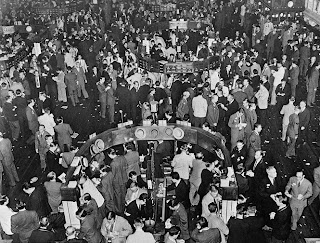
We began trying to recreate the stock market crash of 1929 at last night's rehearsal for The Farnsworth Invention.  In many ways, I wish our audience could peer through the fourth wall and observe this process.  Without set, costumes or lights, this ensemble jumps into the frenetic mood that descended on Wall Street on that fateful day which in many ways defined the century.

Director Claude Giroux does an initial blocking (where and when the actors move) on paper as part of his preparation process, long before we reach the rehearsal stage.  In his mind's eye he can see the effect he is trying to create and with actors on set (taped out on the floor) begins to give specific directions for everyone.  It's a laborious process, but it works.  All of a sudden, the New York Stock Exchange comes alive in the Rehearsal Hall at Keyano College.  It's fun to watch.

I have loose connections to most of the cast members of this show, which is to say they are on my Facebook.  We have a vague awareness of each other but not much beyond that veneer.  One of the great joys of this process for me is slowly getting to know this extraordinary collection of theatre artists, a healthy mix of both students and community members.

I've been a fan of Adam Zacharias for a number of years, but we've never had the opportunity to occasion to chat.  A Westwood graduate, Adam went through our Drama program at Keyano and hopes to pursue a career as a voice artist.  I think that's pretty cool.

Adam Zacharias in Chicago
Adam is one of about 20 in the ensemble who inject rehearsals with incredible focus and energy.  I would guess that most of the general public would have no idea how much time and effort goes into the creation of a Keyano Theatre Company production.  In an average week, as many as 30 hours are spent doing scene work.  Add in the time required to research and learn lines and you're essentially looking at a second full-time job for many of us.

I've said before that The Farnsworth Invention is one of the best plays that I've ever read.  But seeing it leap off the page is something entirely different.  I hope you will join us to see the finished product at the end of April.

Tuesday, March 20, 2012

Return of Ian Hill

Ian Hill, March 19, photo by Paul Jen

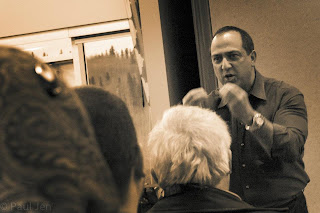
The return to Fort McMurray by former venture capitalist, current philanthropist Ian Hill following his transformative time here in January during the Leading the North conference was much anticipated.  Many of us gathered at MacDonald Island last night to mix, mingle and absorb the infectious enthusiasm of this incredible motivational speaker.

Something (or several things) about Fort McMurray has descended into Ian's gut, something that compels him to believe that we have the capacity to "define history," to become the next Athens.  He posits that we have the perfect mix of talent, treasure and alignment to make this happen, to be a "beacon of hope for the world".

There were two ideas or concepts that rose to the top for me in this 90 minute presentation/discussion.  The first one pivots around the fundamental flaw of human nature to do the things we do because that's the way  they've always been done.  How many organizations are doing kinda/sorta/maybe the same things?  How many like-missioned nonprofits are fighting against each other for the small scraps of available funding dollars?

Mr. Hill suggested that in every community there are examples of organizations who continue to exist though their time of relevance has come to end.  Do we have some of those?  Do we have organizations that could be more effective and sustainable if they were to merge?  I don't have those answers, but I think they are questions worth exploring.

The other itch that Ian was trying to scratch during last evening's session was the idea of harnessing our untapped human capital through the power of making new connections.  If we surround ourselves by the same people within organizations and initiatives, the best, most innovative ideas will remain unearthed.

He used the term "loose relationships," which to me is problematic due to its unavoidable counter meaning. I like the term "new connections" better, as it captures the idea of reaching out to the streams of people coming into our community who have incredible talents, passion, and energy.  We were recently blown away by this dynamic at the Leadership Wood Buffalo information evening.

"What are you doing to tap into those of us here who don't get into the program," asked a young lady in attendance.

I believe that was a key question that Mr. Hill was suggesting we need to ask ourselves and find an answer to in the coming weeks and months.  He used the word "ignite".  The moment he said it I felt like it fit perfectly.

IGNITE Wood Buffalo - I feel a newcomer mixer coming on!

Thanks Ian.  Enjoy your week in our region!

Sunday, March 18, 2012

Farnsworth Chronicles, 3

I'm not sure what the better metaphor would be to describe the blocking of this production of The Farnsworth Invention: building a puzzle or playing a game of chess?  Watching director Claude Giroux move the actors around the set for seven hours yesterday, I would suggest it's a little of both.

In the show, you have a lot of people (the cast is 21 large) playing multiple roles, moving multiple set pieces and executing lightening fast costume changes.  Trying to map that all out at the very beginning of a rehearsal process is a job that requires infinite patience and resolve.

The stage manager sits at a table, diligently capturing all the notes of when and where people are supposed to move, as her version of the script truly become the road map for the production.  And just when she has everything marked down, a slight adjustment is made and she has to reorganize it all.

Cast members wander about with script in one hand and pencil in the other, jotting down reminders of when  they are supposed to enter and from what entrance.  All of this is done in the rehearsal hall at Keyano College with the outline of the set and various staircases taped out on the floor, replicating the scale of what will be built on the mainstage; we won't move on to the actual set for about a month.

David Sarnoff
My job in all of this is remarkably easy.  Being one of two narrators (of sorts), I do more observing than anything else, watching this memory (and apology) play out in front of me.  In the rush and excitement of becoming "the world's first communications mogul", David Sarnoff made choices, some of which cast shadows and doubt on his character and integrity.  In many ways, this story is a coming to terms for Mr. Saranoff, a deconstruction of guilt, an exploration of what might have been.

I survived my first long rehearsal day since 2006, as we managed to block the first half of act one.  I grabbed a piece of floor during the lunch break, folded up my winter jacket for a pillow, and laid down for a 10 minute snooze.  After that, I was good to go for the rest of the day.  I am my father's son; there's nothing that a little nap can't fix.

Saturday, March 17, 2012

Farnsworth Chronicles, 2


The voice is a muscle. This is a lesson I learn over and over again at the start of a rehearsal process.  After a couple of hours of going through lines my vocal chords begin to hurt.  Scratchy, raw, I carry on without certainty that I'll be able to keep my voice together.

After the requisite six weeks of rehearsals, this tenderness will be gone and slamming through long speeches and intense exchanges will be second nature.

Heather and I enjoyed a startlingly wonderful performance by Elton John a number of years ago, a show several hours in length.  His voice was strong as ever, even after a vocally demanding concert and despite the fact that he was suffering from a bad cold and had a sore throat.  The voice is a muscle, and like anything else it needs to be trained to withstand everything that a performance demands of it.

"I need to focus on staying in the moment," I said to Heather yesterday, echoes of a conversation I had with a respected colleague at the recent NCMPR conference in San Francisco.

The hardest part about playing one of the leads in a Keyano Theatre Company drama series show, apart from having to learn lines and get on stage in front of hundreds of people, is adjusting for the incredible amount of time we need to spend in rehearsals.  If I focus on how little time I'm going to have to do everything else, my head will explode.  So, I'm determined to take each day one at a time, using the wee hours of the morning to keep on top of things, along with a precious day off on Mondays.  Tuesdays remain dedicated to council meetings.

Between now and the end of the run of The Farnsworth Invention, I'm going to be saying "No" more often than usual, a word that I've never been entirely comfortable saying.  But I'm just going to have to get used to it and soldier on toward closing night on May 5th.

Friday, March 16, 2012

Farnsworth Chronicles, 1


Surrounded by young, energetic, talented actors, I was feeling my age at the first read through for Keyano Theatre Company's production of The Farnsworth Invention.  That was me 25 years ago, I thought to myself, recalling fun times with Newman Players back at St. Thomas More College in Saskatoon back in the mid-1980s.

While the cast is essentially just getting started with its process, the production team has been hard at work on this show for months, and in some cases, years.

"When I first came to Fort McMurray three years ago I asked Russell to read this script." said Director Claude Giroux.  "Now here we.  This is one of the strongest plays I've ever read."

Jennifer Goodman unveiled her stunning set design at last night's first read through, giving us the sense of the staging, colour palette and functionality of the set pieces.  Tiffany Bishop revealed the wardrobe treatment for the show, creating a sense of memory through mostly greyscale costumes, with the exception of Philo Farnsworth (Michael Beamish) and his nemesis David Sarnoff (me), who will be draped in colour.

I have been working on the opening monologue since the day I was offered the role of the founding President of RCA.  So, when the time came to start the inaugural read, I set the script aside and plunged forward.  I had to glance at the page once or twice, more out of nervousness than anything else, but I made it through.

The thing I am most afraid of, to be completely honest, is the time commitment and the late nights.  Being a creature of habit, I'm often in bed by 10 pm.  But this rehearsal process may require me to flirt with 11 pm and 11:30 pm for the next six weeks.  I'm going to need to eat my Wheaties and "drink lots of water," as suggested by Stage Manager Steph Link.

It has been six full years since I played on the big stage at Keyano.  It's nice to be back, helping to bring to life a brilliant story penned by the incredible Aaron Sorkin.  I hope you will consider joining us for a story that pulls back the curtain on the invention of television.  You can click here for show details.

Wednesday, March 14, 2012

Breathing Alcatraz


New York has Times Square, Philadelphia has Independence Hall and the Liberty Bell, but in San Francisco, it is Alcatraz that draws people in, by the thousands daily.  One would think that on a day with rain falling from sunrise to sunset that demand for tickets to visit this historic rock in San Francisco harbour would subside.  No such luck.


We squeezed onto the ferry early in the afternoon, grabbing a piece of real estate on the top deck, umbrellas protecting us from the pelting rain.  People from all over the world were joining us on this short 20 minute excursion to one of the most famous maximum security prisons in America.  Though it closed almost 50 years ago, it remains as one of the city's top tourist draws.

Alcatraz Shower Room
As we entered the main building and circled around the showers to get our audio units and headphones for the self-guided tour, the thought that some of the most notorious criminals of the previous century would have been cleaning themselves en masse right next to where I was standing was a little creepy crawly; I'd be lying if I said otherwise.


Walking down Broadway, the centre hallway lined with cell after lonely cell, stark with a sink, toilet, bed frame, fold down table and bench seat, the murmurs and machinations simmered in the background.  The audio recording, complete with the sound of jail cells closing and inmate protestations added an eerie sense of reality to the experience.

Robert Stroud from AlcatrazHistory.com
Listening to tales of Robert Stroud, the famous "Birdman of Alcatraz", Al Capone and George "Machine Gun" Kelly standing right next to where they laid their heads every night for years was surreal.  Being mere feet away from where three prisoners (Frank Morris, John Anglin, and Clarence Anglin) chiseled their way through the air vents on the back walls of their cells enabling their passing into the adjacent utility corridor, up to the roof and into the water to an end that we'll never know, was worth the price of admission all by itself.

Alcatraz Library
Prisoners came and went during the 29 years of its operation as a federal prison (1934 - 1963), over 1,500 in total.  Four wardens and countless guards and their families called this 22-acre island home during that time.  And while it's hard to imagine what it was like, as many of the out buildings are crumbling, mere shadows of their former selves, this was a community.

Alcatraz Control Room
Standing in the administration office, staring into the control room, it was easy to imagine the chaos that ensued when guards realized that three beds were being occupied by fake heads and that an escape attempt had actually succeeded.  As they scrambled to read escape procedures, you could almost feel the elevated heart rates and adrenalin, ripples of anxiety and excitement stretching across the years.

Attorney General Robert Kennedy signed the death knell of Alcatraz, a decision to close the facility made out of escalating costs and a deteriorating infrastructure, not to mention a community that was tired of raw sewage from the Rock being dumped right into the bay. It was closed as a penitentiary on March 21, 1963.

I'm glad we went.  The audio self-guided tour thing was awesome, elevating the experience in a way that I really enjoyed. History was brought to life on this Alcatraz adventure and I would highly recommend it for anyone visiting San Francisco.  I suspect, owing to day after day of sold out tours, that many others have done exactly the same.

NCMPR 2012 - San Francisco - Day Three

Someone said that if you can take just one great idea back to your college, then your time spent at the NCMPR national conference would be worth it.  By that modest measure, I'm definitely getting my money's worth, and then some.

In addition to tweeting the light bulb moments as they go zooming by - well over 100 so far - I doodle in my precious black book, in the margins of the program, and on the various handouts that the gracious presenters pass out to help reinforce their message.  Trying to stitch it all together 24 hours later is like creating one of those patchwork quilts that my Mémère (Grandma) used to make back in the 80s and 90s.

Yesterday may have been helped by the pelting rain and fierce wind offered up by Mother Nature for the grand city of San Francisco.  Even dashing from the Huntington Hotel over to the Fairmont proved to be a moist endeavor sans umbrella.  Being inside, gathering nuggets of wisdom, was not only the best use of our time, but the driest and warmest.

I'm so glad I picked Nicole Finkbeiner's (Kellogg Community College, MI) session on Broken Windows theory to start the day.  She was absolutely awesome (a sentiment I heard more than once before the end of the day).  Her presentation style and ability to engage the room was inspiring.

(from the NCMPR program) "In 1982, two social scientists developed the Broken Window Theory of Criminology to explain how people's perceptions of something, such as a building with broken windows, can affect their behaviour."

"What are the broken windows at your college?" she asked.

At this point my mind started swirling with ideas and with whispers of a session attended several years ago facilitated by Brenda Robinson, who challenged us to do something similar.

Nicole suggested five key areas we should be looking at as community colleges: 1) Facilities, 2) Product Quality, 3) Customer Service, 4) Communications, and 5) Pure Irony.  As we broke into small groups we heard frightening tales of unkempt bathrooms, aging and putrid infrastructure, signage that was just plain wrong, and sports team names dripping with prophylactic proturbance. Customer service cries erupted from the room with a mere mention of the Financial Aid department.  (I wonder if this is an American thing, as our Financial Aid office is great?)

What are your broken windows and can you afford not to get them fixed?  No.  A Broken Window audit might be something to consider to get an unfettered view of just how cracked your institution might be.

From the Broken Window side of the pool I swam over to the ROI section for some aquatic synchronization with Kathy Corbalis (Atlantic Cape Community College, NJ) and NCMPR President-Elect Sally Cameron (Bristol Community College, MA).  Together, they started getting the water moving talking about ROI (return on investment) and how we can more effectively demonstrate the value of the marketing and communication choices that we make.

In these challenging economic times, senior leadership are asking essential questions at to what the institution is getting back for its investment in both advertising and resources (human).  One great suggestion, a mantra we should all utter before launching into any new campaign or initiative, is "How will I measure it?"  Another example of starting with the end in mind, you have to imagine the data that would prove most useful, not only justifying your tactics, but also providing valuable insight into what you need to be doing in the future.

I won't list all the resources provided by Kathy and Sally in their post-session handout, but watch for it on the NCMPR website as it might provide a solid starting point if you are weak in this particular area.

My morning ended with Barb Dreger's (Fox Valley Technical College,WI) rousing session on tying your social networks together.  She did a brilliant job of contextualizing why social media is so important and not to be ignored.  The work they have done at Fox Valley has been remarkable in producing tangible results and more vibrant (and sticky) webs to their students.

A couple of things stood out for me, chief among which is the fact that their President's Blog is a key driver of traffic to their website.

"Organizations using social media have doubled in the last five years," she said.  Only a small percentage have chosen not to jump aboard and I can't help but wonder why.

"Attention is the new online currency," she posited.  In my view, if attention is the currency, then influence is the gold standard.

Barb and her crew at Fox Valley are doing great things.  The fact that she has over 4,000 followers on Twitter makes me both envious and curious as to how she has done it.  Talk about influence!

A stunning view of San Francisco in the Crown Room atop the Fairmont Hotel, exciting Paragon Awards presentations and a delectable banquet brought day three of the NCMPR national conference to a close.

Tuesday, March 13, 2012

Making Social Media Magic - NCMPR 2012

We thought it might be useful to the share the script we developed for our "Making Social Media Magic" presentation at the 2012 NCMPR conference.  While it won't be verbatim  to what delegates heard who were able to get into the session, it certainly contains most of the points, and perhaps a few that we missed.  If you have any questions or comments, you can certainly leave your thoughts on this blog post, or contact us directly:

Renee Summers - Marketing Manager - renee.summers@keyano.ca
Russell Thomas - Director - russell.thomas@keyano.ca


Making Social Media Magic
March 12, 2012
San Francisco, CA


RUSSELL: Thank you so much. It is both an absolute thrill and an absolute terror to be on this side of the microphone after attending four previous NCMPR conferences in Savannah, Kansas City, Albuquerque and most recently in Philadelphia.

Before we go any further, I want to try something. I’ll need complete silence and attention for this. I’m going to show you a picture. If you have any sense as to what it’s about, please quietly raise your hand.


RUSSELL: That is SOCIAL MEDIA MAGIC. The KONY 2012 video was release one week ago today. What a difference a week can make.


RENEE: The title of our presentation is MAKING SOCIAL MEDIA MAGIC. We’re going to talk about the basics of platforms like Twitter and Facebook, give some interesting anecdotes about how they’ve become an important component of our marketing and communication mix and provide a few examples of things we’ve learned along the way. We’d also like to make this session as interactive as possible. So, we’ll be throwing out some challenge and test questions to get your thoughts and ideas.

RUSSELL: The reason that this presentation is rather daunting is that some of you come from colleges that are gargantuan, with multiple urban campuses, tens of thousands of students, and budgets that would put ours to shame. Others of you come from more modest roots, community colleges with a smaller number of students, small staffs, and budgets that force you to pull value out of every minute of your day. Are we up here as experts? No way. Have we figured it out? Not even close. Are we having fun trying? You bet.


RENEE: Our first test question, which should give us a quick sense of the room is: HOW MANY PEOPLE IN HERE KNOW THEIR PERSONAL KLOUT SCORE? HOW MANY PEOPLE KNOW THEIR COLLEGE’S KLOUT SCORE?

RUSSELL: KLOUT is a readily available online tool that automatically measures your influence using data from your social networks.

This is directly from their website: “Anywhere you have an online presence, you have the opportunity to influence people by creating or sharing content that inspires actions such as likes, retweets, comments and more. The more engagement your posts receive, the more influential you are. Klout uses this information to provide you a Klout Score that measures your overall influence.”

IMPORTANT: If you’re doing the right things with your college social media channels it will be reflected in your Klout Score. The same applies if you’re doing the wrong things.


RENEE: So we are thrilled to be here in San Francisco for the 38th annual NCMPR Conference. We are from Keyano College which is located in Fort McMurray, Alberta, Canada….proud members of ZONE 7!  But you might be asking yourself WHERE IN THE WORLD IS FORT MCMURRAY AND WHY WOULD I CARE?


If we pull back on the map and show all of North America, you see San Francisco here in northern California, followed by Oregon, Washington, and British Columbia. We are off to the right in Alberta. This is CALGARY. Keyano College is a 7.5 hour drive directly north!


RUSSELL: Why you should care and how what happens in our region affects you is all contained is a 50-mile radius of Fort McMurray. Something called the Athabasca Oil Sands.


For the record, Renee hates this picture that I chose, but I think it’s illustrative as this is the Syncrude Upgrader facility with the sun setting off in the distance. This facility is in the heart of the 3rd largest proven supply of oil in the world.

175 billion barrels reside within that 50-mile circle, recoverable using today’s technology.

Over the next 25 years total investments, reinvestments and revenues from oil sands operations will top $2 trillion as we go from producing about 1.7 million barrels per day in 2012 to almost 5 million barrels per day by 2035.

Over the next 25 years, the number of jobs to be created in the US directly as a result of the activity happening on Keyano College turf: 465,000.

Right now, the Athabasca Oil Sands region is America’s #1 of non-domestic oil.

RENEE: And as the college in the heart of the biggest industrial development on the planet, we play a big role training the people they need (in frighteningly increasing numbers): power engineers, steamfitter/pipefitters, welders, crane operators, heavy equipment technicians and heavy hauler operators.


Our state of the art simulators prepare students to drive some of the biggest pieces of equipment in the world, like the Cat 797. The cost to replace just one of these mammoth tires? About $50,000.

RUSSELL: So, in as little time as we could manage, that’s a little bit about who we are and where we come from.


RENEE: This is an aerial shot of our beautiful community and campus.

We serve a region that has a population of just over 100,000. Our average household income is the highest in the province at about $180,000 fueled by thousands of well-paying jobs in the oil sands at plants that run 24-7, 365 days of the year. We are shiftwork community.

We make lots of money, but a lot of that goes to the high cost of northern living, including house prices that average $750,000. To illustrate that further, a nice mobile home on a lot, sells for over $400,000.
We are young. The average age is 32. We don’t have a lot of seniors.

We are highly educated. Over 65% of the population has credentials achieved beyond high school.

WE SERVE A YOUNG, GLOBAL, PLUGGED IN, POPULATION WHO WORK HARD, PLAY HARD AND COME FROM ALL OVER THE WORLD.

What does this mean for Keyano College?

SOCIAL MEDIA HEAVEN


RUSSELL: and then along comes Facebook. It went mass market in the fall of 2006, yet by April 28th of 2007 I had heard the term “Facebook” maybe twice. I didn’t really know what it meant or why would it would matter to me or Keyano College.

But, on that day, in a meeting with theatre professionals from around the province, in between agenda items, all they could talk about was this thing called Facebook that was sweeping through colleges and universities. I went back to my hotel room and signed up that night. And from that point on, Facebook was everywhere. It had reached a significant tipping point.

I got Facebook right away and ran right into the cliche that embarrassing pictures of you will invariably show up.  This picture of me drinking my first beer at a party in 1983 showed up within the first week of joining.


Note the sexy wristbands and stylin' white pants.  I was cool.


A horse of different colour is Twitter. I first heard about Twitter right here at the NCMPR Conference in Savannah. Dr. Pam Cox-Otto from Interact Communications was giving a presentation on social media while several members of her staff were in the audience tweeting on Twitter. I had no idea what that meant or what that looked like or why I would possibly want to try it myself. But I did. I went back to my hotel room and signed up.

It quite a long time to get the hang of Twitter. Facebook seemed easier, more applicable, more personal. But it during the glory days of the Vancouver Olympics that I discovered one of the practical uses for this micro-blogging platform.

 
The sport that I was following the most was curling. And both the Canadian men and women ended up in the finals. And both those games ended up happening at a time when I was in the middle of a packed theatre watching my kid perform in a show.

I figured out that if I put in the proper search using my BlackBerry that there were thousands of people tweeting what was happening in realtime. And as the Canadian men won, I let out a muted cheer, and discovered that 4 or 5 other people in the audience were doing the exact same thing.

During our most recent convocation and myriad other special college events, I took that lesson and turned it around, tweeting in realtime about events that mattered to us that we hope would matter to others. It didn’t cost any more money, all the work had been done for the event, we just maximized what was happening by sharing it on our social media channels. It’s a tremendous brand builder.

As the social media bubble began to get bigger and bigger, with no sign of going away, I gathered my staff together and said: “I DON’T CARE IF YOU’RE DOING SOCIAL MEDIA PERSONALLY, BUT I ABSOLUTELY NEED YOU TO BE DOING IT PROFESSIONALLY.”

Which leads to an interesting challenge:  PERSONAL VS PROFESSIONAL PROFILE?

RENEE: what kind of profile do you develop?

• A singular profile that speaks to all your activities: personal, work, community.
• Multiple profiles that separate the personal from the professional.

Russell, how have you approached this particular challenge?

RUSSELL: I guess from the very beginning I chose to share all aspects of my life using one profile. It has its limitations as I have to be very cautious on the kinds of things I post, but overall, it’s worked well for me.

RENEE: Does anyone want to share the choice you’ve made and why?


RENEE: The other thing that happened during the early stages of this social media revolution was that departments and programs got on the bandwagon. All of a sudden, Keyano College pages were popping up everywhere. It was out of control.

Departmental/Program pages – Managing the Beast

Did anyone else go through that phase?  Is anyone still in that phase? Would anyone be willing to share a strategy that has worked for your College?

We started the process of reining departments in and linking their social media activities with the “mother ship”, so to speak. And now that we’ve achieved some sense of control and the Board has instituted a social media policy to create a framework, we are in a much better place.

That said, we’re truly still trying to figure it out. Every day provides challenges and lessons about how to harness the incredible potential of having these direct channels to our students, stakeholders, and potential students.


RENEE:  My facebook story started with my daughter.  I discovered that here was an awesome way to share tons of pictures without cramming everyone's email inboxes.

But over time, my page has changed to be much more business focused.


RUSSELL: We’ve learned so much, and there is still so much more to learn. But we thought we would attempt to collate 10 specifics lessons or ideas that you can take back to your colleges.


We have a handout piece that you can take as a parting gift. So don’t feel like you need to write these down.

USE SHORTENED URLS

Whether you use bit.ly or goo.gl, shortened URLs offer insight into what is working and what is not. I use bit.ly and here is some information that it provides.


Not only does it show how many people clicked through, but whether they clicked through on Facebook or Twitter, mobile or otherwise.

Why is this important? Because it is a direct way of measuring your effectiveness in engaging your audience.

CREATE EDITORIAL SCHEDULE

I think there are two kinds of people in the social media world: those who tweet and post instinctively and just have a knack for weaving it into their busy lives, and the rest of us. How do you create a meaningful social media presence if you or members of your team are not wired that way?

The first step is to create an editorial schedule of things you need tweeted and multiple ways that you want to present and share that information. Tweeting or posting once is not going to move the meter. You need to have a rational balanced approach to sharing information within the social media realm.

When are most people engaging? Are you sending out messages at those times?


For instance, SocialBro.com offers a mechanism to browse your Twitter community and provide you a whole menu of statistics that should inform your editorial schedule.


Using a dashboard like Tweetdeck or Hootsuite gives your team a tool where they can dedicate 30 minutes of their day to programming their social media messaging for the day. You can manage multiple profiles from one location and even schedule updates hours and days into the future.

CONDUIT TO CONTENT

I think of social media as both being relational and a conduit to content. In the process of building brand and awareness, your ultimate goal is to connect your audience with content that matters to them. If you have nuggets buried within your college website, you can use the channels you’ve developed on Facebook and Twitter to bring users into your world.

If I write a blog and it just sits there, it’s going to have next to no views. But one posting on Facebook and Twitter and come flying into the content.


There are lots of interesting things happening on the home page of our website, like an Aboriginal Awareness Day even, a Land Trust endowment story, and even someone attempting to break a world record, but if don’t invite people to engage with this content via Facebook or Twitter, we are not maximizing its potential.

SET GOALS

This is a pretty simple concept: keep track of your social media channels so you know how you’re doing.

“What gets measured gets done.” If we see that one particular channel has flat lined, we can marshall forces within the college to give it a jumpstart.

Set targets for audience and challenge the college community to help you achieve them.
Even asking your audience to help in building more audience seems to work.


KEYS TO SUCCESS: take regular measurements and share the results. We use a red light, yellow light, green light approach to quickly identifying areas of success and challenge.

WATCH, LEARN, LISTEN

You don't have to reinvent the wheel.  Look at what your colleagues at other colleges are doing.  Certainly one of the most successful has been Harvard University with over 1.5 million fans of their Facebook page.  Look at the type of content they are adding and the frequency with which they are adding it.


CONTENT IS KING

At the end of the day content is everything. What it is, how and when you share it, and how often.

RICH, RELEVANT, TIMELY, AUTHENTIC

RICH – use images, links, videos – tweets with links are more likely to be retweeted.

RELEVANT – the higher the relevance the higher the resonance and SHARE FACTOR. Are you saying stuff that matters to the people in your audience?

TIMELY – timing matters and the sooner the better. What’s going to get more retweets, talking about Wayne Gretzky coming to Keyano College as it is being announced, or the next day when it’s already old news. This one’s a no-brainer.

AUTHENTIC – authenticity makes a tremendous difference in the social media world. About a month and a half ago, it was a particularly cold day in Fort McMurray, -40 or so, and I felt like grabbing a cup of coffee. So I walked from my office, which is in one building, to the other building where the cafeteria was located. As I was walking back, I glanced down and noticed that I was wearing two different pairs of shoes.

Anyone else ever do that?

I was mortified, embarrassed beyond, and in a little bit of a panic as I had meetings with important government officials later that morning. So, what did I do?


I pulled out my BlackBerry and took a picture and posted it on Facebook.

The interesting thing here is that this simple posting inspired 73 likes and 53 comments within just a couple of hours, or a response rate of 7%. Why? Because it was an honest human moment that everyone could relate to and it brought some sunshine to their very cold Alberta day.

KEY QUESTION: HOW DO YOU ACHIEVE AUTHENTICITY WITH THE COLLEGE VOICE?

24-7-365

Social media never sleeps. It doesn’t fit into a nice Monday to Friday, 9 to 5 box. How is your college responding to that reality?

We live in a shiftwork community, where people are engaging online at all hours.

Everyone needs to have a CHAMPION and the team needs to be empowered to be the eyes, ears, and voice of the College.

A whole lot of damage can occur to your institution during the weekends or at night when everyone is sleeping, or so you assume. Conversely, huge opportunities for engaging your audience exist outside the parameters of your normal business day.

This is a puzzle we have yet to solve, though we know it’s incredibly important.

RUSSELL: An example of this occurred last May 16 when I saw a Facebook post from a colleague at Northern Lakes College saying that she was becoming increasingly concerned about the disturbing images coming out of Slave Lake. I flipped over to Twitter to find out that a massive forest fired, fueled by 100 mph winds, was threatening this small community of about 7,000 people.


I spent the next six hours tweeting information, pictures, video clips of what was happening. Not only did my twitter followers jump dramatically, I had a call the following morning from the producers of the CBC National news wondering if I knew how to get ahold of the town’s mayor as I was obviously tapped in.
In the end, 40% of the town was reduced to ashes. The fire was so hot that concrete foundations literally melted. Where did people in the middle of that disaster go to find out information? Twitter and Facebook. Those became lifelines for people who didn’t know if they had a house to go back to.

ENGAGE THEM AND THEY WILL ENGAGE YOU

If you want to go duck hunting, go where the ducks are. People are spending an increasing amount of time in the social media universe connecting with them, engaging them in dialogue, building relationships and networks.


How powerful is this social media dynamic? Last year, we need to advertise a Cash and Carry Sale for our facilities department. It was essentially a gargantuan garage sale where you could pick up surplus items for next to nothing.

We were selling flat screen computer monitors for $5…as an example.

They didn’t give us enough notice, so the only marketing we were able to do was using our Twitter and Facebook social media channels.

With not a single iota of traditional media support, the gymnasium full of surplus items sold out within a couple of hours.

We needed to go duck hunting, so we went where the ducks were.

50 / 25 / 25

One of the key questions that all of us are asking is WHAT DO I TWEET ABOUT? Or, WHAT DO I POST ON FACEBOOK?

One theory is to use the 50-25-25 approach.

50% of the time your content should be about your core business
25% of the time your content should be engaging your audience about your core business
25% of the time your content should be “whatever”….fun stuff

At the end of the day you’re wanting to achieve increasing engagement, more likes, comments, shares, and retweets.


I think our best example of fun stuff happened on Halloween last year. Staff members were invited to bring their little kids to the College to go trick or treating through the various departments. Our photographer had the brilliant idea of inviting every group into our photography studio to get their pictures taken.

They turned out so well that we posted them on Facebook and then sent them out on Twitter with hourly Halloween safety messages.

Did it have anything to do with our core business? Not even a bit.

Did it build brand for the college and increase engagement? Absolutely.

It also presented an opportunity to demonstrate that we a college that supports families and community.
It was a home run.

GREAT CONTENT IS WORTH REPEATING

When your radio morning show runs a contest where they give away a trip to Hawaii between 6 and 6:20 am that results in a most amazing exchange with the winner….what do they do?

They repeat it….over and over again.

Why? Because great content is worth repeating.

And much like radio, where only a percentage of their listeners are tuned in at that precise moment, you want to share and post your most important content multiple times, over a number of different day parts to get the highest penetration and engagement.

Only 16% of your Facebook audience will see any one post.

RUSSELL: Tweets are flying in at an incredible rate. I follow roughly 1,500 people and at the busiest time of the day, I’m seeing 20-30 tweets per minute. If you want to cut through, you’ll have to find ways of getting your content sent out multiple times in multiple ways.


The reality is that we are all exploring a new frontier. As my wife sat at the computer with my 8 year old son Ben last Thursday evening watching the KONY 2012 video and what it meant, she made an astute observation, that this campaign had set a new benchmark for how to use social media to change the world.

A colleague of mine on Municipal Council recently said “That the only mistake we can possibly make, it to think too small.”

He was talking about urban development in Fort McMurray, but I think the sentiment applies directly to the relationship between colleges and their social media networks.

Focus not on your limitations, but on your opportunities – think beyond the obvious and imagine the possible.

Thank you.