Thursday, August 30, 2012

Controversy on the Snye


I have often described the confluence of the Snye and Clearwater River as being "my happy place".  If you were to add up the amount of time I've spent on that sandy point (called Willow Flat on a map from 1910) it would equate to full days, likely weeks. I've done a lot of fishing and enjoyed many hours of calm reflection and communion with nature at that spot, just a few short blocks from my house. There is a lot of personal connectivity, not to mention local history, contained in this waterway that once was connected directly to the Athabasca River.

A controversial decision back then, a land bridge was constructed in 1964 to facilitate access to, and development of, MacDonald Island.  Approved by the council of the day and considered a death sentence for the Snye by others, the dyke road ultimately led to the incredible gem we have today with the Miskanaw Golf Course and the Suncor Community Leisure Centre.  Sadly, the small stretch of water that used to flow either east or west depending on the height of two two rivers it connected, is a shadow of its former self.

As a resident, I've been reading about Snye remediation schemes for the better part of a decade.  One study after another was commissioned with solutions ranging from blowing out the dyke road and putting in a bridge to increasing the size of the culvert that runs underneath the dyke to allow a greater volume of water in from the Athabasca.  Millions of dollars have been spent in trying to figure out how to bring this historic water body back to a healthier ecological place.

Meanwhile, activity and use of the Snye has marched on.  I've seen firsthand the exponential increase in the number of boats accessing the water and the inordinate number of PWCs (Persona Water Craft) or Sea-Doos that take over the Snye space adjacent to the spit of sand that often is filled to the brim with vehicles spending some time by the water.  As the watercraft have increased their activities, the float planes have dramatically reduced theirs.  In the three months since the fishing season opened on the Clearwater, I've seen two planes land on the liquid landing strip running parallel to the proposed-to-be-closed Morimoto Drive.

Community groups with interests in the Snye were given a heads up by municipal staff about changes proposed including turning the historic waterway into a DMZ, or de-motorized zone. Citing an ecological imperative that is requiring the removal of motorized craft, officials have said that it is one of several remediation steps that are necessary to "fix" the Snye. In order to set the stage for massive development, vehicular access to Morimoto is also proposed to be taken away.

Some community groups and users are supportive.  Others are incensed and making their feelings known, not buying the rationale that is being dished out, or the alternatives being suggested at various locations along the Clearwater.  They are passionate about the role the Snye has played in the history of Fort McMurray and in their lives, and they are fully engaged in holding our proverbial toes to the fire on this one.

Albert Einstein defined insanity as doing the same thing over and over again and expecting different results. We need to do something or the Snye will die.  It is already a hazard with the proliferation of weeds, brought on by a long hot summer and stagnant water.  Fuel residue from motorized users along with tonnes of storm sewer detritus don't help the situation, though they represent only a portion of the problem. The confluence requires yearly dredging as sand builds up making it very difficult to safely get through to the Clearwater late in the summer.

If the changes go forward, then my access to my "happy place" changes dramatically.  I will likely have to park somewhere close and walk over, assuming the finished product will be angler-friendly.  Others will have to find a different place to launch their boat or race their PWCs.  Lots of us have skin in the game, so to speak.  I understand why people are so activated on this issue.

At some point, the full proposal will make its way into the public realm where citizens can share their perspectives, municipal council can listen to all the facts, debate the issue, and make the best decision possible based on the facts presented.  Between now and then, my hope is that many respectful conversations take place, perspectives are heard, and all sides of this issue are explored.  We want to get this right, once and for all.

Wednesday, August 29, 2012

Pulling back the curtain

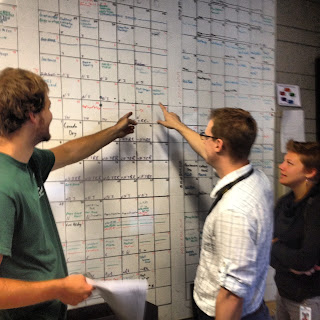
Shawn Watson, Nick Beach and Steph Link at the whiteboard

In the days before the start of a new season of plays and concerts, the staff of Keyano Theatre and Arts Centre is focused on the present, but ever so mindful of the future. In this world, they plan more than a year out, marrying up available space with usage requests from multiple projects and multiple community clients.

In Nick Beach’s office – he’s the Production Manager for the TELUS Drama Series – a huge whiteboard covers an entire wall, a checkerboard of dates and months that provide a snapshot of all the events scheduled for the main performance spaces in this storied facility that includes the main theatre, opened in 1980, and the Norm Weiss Arts Centre which sprang to life a decade later.

“It’s been a busy week,” he said.

“We started building the Extremities set, pulled furniture and rehearsal props, and started construction on the next show. This is really a staff chessboard and Eugene (Production Manager for the concert series and for rental clients) and I are always plotting three to six months ahead.”

There is art in organization, and it is in abundance with these theatre professionals as they map out light hangs, focus sessions, rehearsals, set installations and a million other details with available technical resources and time. Holding it all together is a task that requires a dash of precision and a pinch of flexibility, as best laid plans often go awry.

“Thrilling,” is the word that Alan Roberts used to describe this period of time just as the season is about to get underway. He is the Director of the Theatre and Arts Centre and is about to begin his 25th year at Keyano College.

“Relief is another emotion that I feel right now, relief that we’re beginning to start. You can plan all you want, but it feels great when things actually start happening. The bulk of my attention is on Calendar Girls right now, as the Extremities train has pretty much left the station.”

With contracts signed, marketing collateral (fancy term for posters, postcards, web images, etc.) ready to go, and tickets on sale, all systems are go for the Syncrude Arts Alive Presents concert series, 11 different shows stretched out from September 20th to April 13th. Bboyizm’s performance of IZM is first out of the gate followed closely by blues sensation Matt Anderson (love his Christmas CD) and breakout childrens’ entertainers Splash ‘N Boots. In each case, the cache of lighting instruments will need to be reconfigured, refocused and programmed to create a colour palette suited to the performance. If you look closely on the giant whiteboard, you’ll see small notes in different colours, plotting out the necessary steps to make sure all the technical details are ready.


Rehearsals will begin right away for the first play of the season, Extremities by William Mastrosimone. With roughly six weeks till opening, actors will be spending three evenings a week and most of the weekend in the Rehearsal Hall where the schematics of the set will be taped out on the floor to give them a sense of the space they will have to inhabit when they have a set to play on. They won’t move onto the set and into the main stage till October.

Most rehearsal processes are similar, though obviously nuanced by the director (Paul Gelineau in this case, returning to Fort McMurray for a guest directing gig). Actors start out reading the script around tables, talking about character, plot, motivations, and getting a sense of each other. Before the first week is done, the players will likely be on their feet, starting to get a sense of the blocking, or where and when they need to move and why. Flying along and three weeks in, the cast will be furiously trying to get off book (theatrical term for having memorized your lines) while the director dives into working specific scenes.

As the cast members begin their process, the designers have begun moving from the planning to the execution stage. For months, and sometimes longer, they have been huddled over models, drawings, and research, communicating back and forth with the director to make sure that the various design disciplines are heading in a common direction. They share their work and their vision with the cast and crew at the first rehearsal, unveiling the maquette (scale model of the set), colour renderings of costumes, and the initial sense of how the technology will eventually dance with the performances to create the magic of the show.

Maquette for Extremities, designed by Jennifer Goodman

While the actors go through their paces, props, furniture, and the set itself, will slowly get “dressed”, or treated with paint, fabric, technology and other things to get all the pieces ready for an audience. The set designer will spend hours in the paint shop located adjacent to the stage, mixing colours, testing textures and furiously watching the clock as there never seems to be enough time in this phase of the production process. The costume designer will be entrenched in the costume shop, usually with several seamstresses, gathering, building, and adjusting shirts, pants, jackets, hats, and myriad costume pieces that not only need to fit, sometimes they have to come off and on with amazing haste as actors execute quick changes off in the wings.

“What role does flexibility play in what you do?” I asked Alan Roberts.

“We live in a world of constant flexibility,” he said.

“Whether it is changing schedules, changing tasks or priorities, adjusting budgets or making physical changes – what kind of manpower we need to execute certain parts of the process - being able to respond, adjust and keep moving forward is integral to our success.”

When they do their jobs well, you are not even aware of their presence. When you leave the theatre entranced by the story or performance, oblivious to the intricacies of what was happening behind the scenes to make the magic, this talented team of technicians, designers, directors and theatre artists can silently, invisibly take a bow, because they will have achieved their ultimate objective.

For more information about the upcoming season at Keyano Theatre and Arts Centre, visit www.keyano.ca/theatre.

Sunday, August 26, 2012

Mystique of Mindcamp


The moon sat high above the trees, dipping its toes and its light in the waters of Lake Couchiching and on YMCA Geneva Park, the site for MindcampX, the tenth annual gathering of creative thought leaders from 14 different countries.  The remaining few, remnants of over 250 souls who spent the last three days together , sat in a wide circle around a brilliant fire.


Tim Switalski, one of the longtime mindcampers, led the way on guitar, with Anthony Hyatt - multimedia performance artist - in support on the violin, and Franca Leeson - meditation instructor and one of the key organizers of MindcampX - doing the same.  My roommate and creativity coach from New Zealand, Wayne Morris, added rhythm on the bongos with several others like Veta Bates - a creative problem-solver from Brooklyn - helping out with myriad shakers and drumsticks.


The music was imperfectly perfect, a collective effort of some incredible people who have such a natural affinity for one another, that one would think they have spent their entire lives together.

Let me back up and answer two obvious questions.  First of all, what exactly is Mindcamp? And how did I get here, to quote a famous lyric from The Talking Heads.

Mindcamp is an annual gathering of people who have an interest in, or have made a career out of, helping others be more creative.  The first year in this idyllic location, MindcampX proved to be a boon in terms of interest, experiencing astounding year-over-year growth of about 125 participants.  Over 80 different sessions were offered over three days with everything from learning how to express yourself through painting to learning how to run better meetings, from exploring how to fix broken systems to exploring how to shake out stress.


How did I get here? Well, the wind just seemed to blow me this way, to quote yet another lyric, this time by Robbie Robertson. Actually, it started with a tweet sent in my general direction by Mindcamp founder Tim Hurson a number of months ago.  He had asked me whether I was going to the event.  Of course, at that point, I had no idea what it was or why I should possibly want to go.  But I went to the website once, twice, three times before that day was done, before I finally said to myself: What the hell am I doing?  I have to go.  I have no idea why, but there's a reason.

I stood up in front of the participants during the final session and with microphone in hand shared my version of how I will describe what happened at Mindcamp when I go home and why it was so special.

"I go to conferences all the time," I started.  "And at each and every one, about one-third of the delegates want to be there, and the remaining two-thirds are there because they were told to go.  The level of engagement at Mindcamp is completely different. I heard a similar story from four or five different people, who felt like they were called to be here and that they just followed their hearts."


I met some incredible people, like 23 year old Tyler Kellogg from Watertown, New York, who spent a month of his life living out of his car traveling the country offering his help to random strangers as a research project.

I totally enjoyed spending several hours on the van ride from the airport with Brad Partridge from Florida who works for Universal Studios.  He shared an incredible story of when he was a young college student, ending up in a Ronald Reagan presidential motorcade.

So many other names and faces rise to the top when I reflect on the past several days: Natasha, Leena, Bill, Whitney, Fei, Stephanie, Lyla, Barbara, Ana, Jay, Judy, John, Tim, Tony, Zac, Newell, Steve, Judy and so many more.

Sure, I learned a lot about creativity theory and practices.  Sure, I got some great ideas for experiential activities for my family and some of the projects I'm involved with back home.  Those things are great.  But, it is the amazing people I met, relationships that have been formed and will hopefully grow, that made Mindcamp the extraordinary experience that it was.

Something about this conference, the people, and the environment made associating names with faces infinitely easier than at any other conference that I've attended.  I also believe that these are people who have a sincere interest in keeping connected long after Mindcamp is finished.  I could be wrong, but I really doubt it.

Tuesday, August 21, 2012

Discover LeAnn Rimes


On November 3rd, LeAnn Rimes will headline the annual Keyano College Foundation Gala, the black-tie event of the year presented by ATB Financial.  Moe Farhat, Co-Chair of the Gala organizing committee spilled the beans during a media conference this morning at Keyano College.


This annual fundraising adventure and unparalleled night on the town has featured some amazing artists over the years.  Dionne Warwick, Randy Bachman, Burton Cummings, and Blue Rodeo come to mind, though I'm sure some long-timers would add other names to this impressive list.  LeAnn Rimes is a global country music star with 40 million album sales under her belt in her short 30 years of life.


I saw this vocal phenom in 1998 during the Country Radio Seminar in Nashville.  Rimes was on a bill in the original Ryman Auditorium - the one in the heart of downtown - with Hal Ketchum and another artist whose name escapes me after all these years.  Sitting in that hallowed space, her powerful voice rose to my seat on the second level, dancing in my ears, achieving sonic perfection.  She was 16 then - two years older than when she burst onto the scene with her rendition of Patsy Cline's "Blue" in 1996 - still a teenager, but wise (and talented) beyond her years.

That time in Nashville was amazing.  I loved being surrounded by people talking in that southern drawl and enjoyed hearing "How y'all doin'?" more times than I could count.  The people were friendly, the music extraordinary, and the history, everywhere you turned.


I was having a drink in the Bluegrass Inn, two doors down from Tootsie's Orchid Lounge on Broadway, when one of the staffers started chatting me up.

"Are ya hungry?" he asked.

"No," I answered bashfully, not knowing where he was going with the question.  "I'm fine."

"No, really.  Are ya hungry?"

"Well, a little I guess.  Ya, I'm hungry," I said, doing my level best to not slip into the Nashvillian accent, which was quite an effort as I recall.

"Follow me," he said, as he led me out the back door into the alley adjacent to the Ryman, up a ladder to the roof of the Inn.

Up there on the black top of the roof, the graceful home of country music just a stone's throw away, a little Hibachi was billowing smoke.  He lifted up the lid and revealed a succulent hunk of beef that had been cooking low and slow for hours.

"Just rip yourself off a piece," he said brightly, as if I was his favourite cousin from Kentucky, not some random stranger from northern Alberta.

With my boss Kelly Boyd in Nashville

Many years have passed under the bridge since I sunk my teeth into that chunk of beef and most of the memories of that three or four day experience have drifted away.  But I will never forget the hospitality offered in that little bar on Broadway, and chewing that tasty morsel up on the roof, standing in the shadow of the Ryman. And I will never forget sitting in the cathedral of country music listening to the youngest country music superstar to come along since Tanya Tucker in the early 1970s.

Heather and I look forward to Gala every year.  She savours getting dressed to the nines and feasting in the sites, sounds and tastes of this extraordinary social event.  I anticipate the atmosphere, the networking, and reconnecting with that voice that drifted up to my seat on the balcony at the Ryman over 14 years ago.


Sponsorships for this epic event are available now at www.keyano.ca/gala.

Sunday, August 19, 2012

10,000 hours


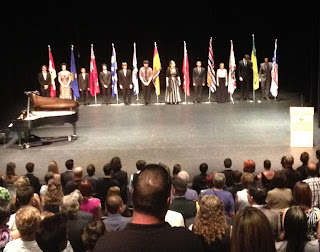
You've likely heard of the 10,000 hour theory espoused by Malcolm Gladwell in Outliers - The Story of Success.  As we sat in the back of the house at Keyano Theatre waiting for the start of the 2012 National Music Festival Grand Award Competition, I thought we were about to experience something special. I would guess that this collection of musicians were just getting warmed up by the time they hit the 10,000 mark.

I was hoping for a bigger audience to be perfectly honest.  This was a national level gathering of artists, a rare treat for Fort McMurray, but sadly it was only the usual suspects and classic music die-hards who were scattered throughout the 600-seat theatre, maybe a third of a house to honour students who had achieved excellence at both their local and provincial festivals.

Ben was particularly struck by the first performance of the MRU String Trio from Alberta.  The violin, viola and cello gracefully passed the melodic line back and forth, going through three movements of Serenade in C Major, op. 10 by Ernst von Dohnanyi.  Not only are they exceptional technical performers at this stratospheric level, they also demonstrated a stage presence that is world class.

Gerard Weber did his (and ours) home province of Saskatchewan proud with an alto saxophone performance that was expressive, surprising, and drop dead amazing.

"Buddy, that was incredible," I said as he walked by us at intermission.  "Go Riders!"

Janice Marple from Alberta did some vocal gymnastics with a few heart-stopping selections for soprano.  What was cool about the voice competition at this festival was that the adjudicator, now living in Mississauga, is originally from Fort McMurray and a distinguished grad of Keyano College - Laura Whelan.

Steve Cowan from Newfoundland and Labrador, blew us away with his classical guitar performance.  An avant-garde piece by Ginastera, Sonata Op. 47 had Mr. Cowan using every part of his instrument, from hitting the body to sliding his fingernails up the strings.  If audience response was any indication, then this impressive performance had to be a front runner for the $5,000 first prize.

"I'm afraid we have a slight change in the program," said Pam Allen, master of ceremonies and President of the Federation of Canadian Music Festivals.  "I'm afraid that Colleen has broken a string and cannot perform, unless someone has an extra E string back at the hotel."

Someone must have come through because Colleen, intense and elegant in her striking red dress confidently stood with her violin tucked under her chin, hands at her sides, waiting for accompanist Frédéric Lacroix to begin her Shostakovitch selection.  I'm happy to say she delivered a wonderful performance representing her home province of British Columbia, the replaced string a forgotten memory.

Jolain Goulette from New Brunswick made magic with the marimba, fielding and finessing four mallets to create a gorgeous soundscape, lunging from one end of the gorgeous instrument to the other.

The winner of the male spirit award, Jonathan Elliotson from Ontario, showed us what 10,000 hours of playing the trumpet sounds like.  He performed Legende by George Enescu eloquently and with total confidence.

And finally, Suren Barry, also from Ontario, sat down at the piano bench, adjusted the height, sat straight up and paused.  For five, maybe ten seconds, he was still, focusing all of his spirit into his upcoming journey through a five movement piece by Schumann.

Individually, these musicians knocked it out of the park last night.  But, collectively they represented tens of thousands of Canadian youth who make music from coast to coast.  As elected officials, as arts advocates, we need to do everything we can to encourage, support and inspire these young talents to keep playing, exploring and sharing.

"And the winner is..." began Pam Ellen, "Steven Cowan from Newfoundland and Labrador."

The audience erupted and stood en masse as the amazingly talented classical guitarist accepted his honour at centre stage, hand firmly covering his heart in humble appreciation.

I kept thinking of Gladwell's 10,000 hours throughout the stunning evening of music, of how much time, dedication and practice goes in to reaching this level of excellence.  I kept thinking that I was in the presence of greatness, and that the moment needed to be savoured, as the chance to enjoy music of this quality is rare.

I'm grateful to the organizers, sponsors and musicians for putting on an evening of music that our family will never forget. Thank you.

Saturday, August 18, 2012

Escape from genocide


Conversations with strangers while sitting along the shore of the Clearwater River usually start with a question about what kind of fish we catch.

"We've been getting a lot of small walleye the last couple of days," I said.

"Walleye, really?" said the tall black man, framed in the hazy light of the early evening sun, hanging bright above the eastern end of MacDonald Island.

From What are you doing in Fort McMurray? to Where do you live? to Where is home home? a picture and a story began to take shape of a man steeped in gratitude harbouring a dark and violent past.

Owen is actually a family man from St. Albert, up in Fort McMurray for a time working a turnaround at one of the oil sands sites.  But way back into the early 1990s, he was a young man caught up in the war-ravaged African nation of Nigeria.

"People were captured, lined up and executed, right in front of me," he shared.

Brought up in a polygamous family with his father - a contractor who built homes and a trader, his birth mother - the matriarch of the house, five other wives, and some twenty siblings, the edge in Owen's existence was especially cutting.  His father and mother came from opposite sides in the brutal war that was ripping their country apart.

"My father was from the federal side while my mother was from the rebels," he said.  "There was always a fear that my dad would be executed for it."

At one point, with federal officials about to close in, he vanished from his community and family.

"One day he just disappeared," said Owen.  "We couldn't know where he was hiding, for our own protection.  He was gone two years."

Owen made his escape in 1994, first going to Bulgaria, then on to Germany and finally the UK.  Coming to Canada about a decade later proved to be the best decision he ever made.

"The moment we arrived in this country there was a sense of peace and safety that we'd never known before," he said.  "I'm not sure if you have any idea how good you have it."

We talked about a lot of things sitting there waiting for the fish the bite: family, community, inclusion, diversity and oil sands.

He is befuddled as to why the environmental lobby is so opposed to oil sands development.  He described what happens in his home country, devoid of regulation and environmental controls.  Waterways are completely sacked of life, overwhelmed with pollutants, while wide swaths of forest have been decimated by unfettered flaring.

For Owen, who has a young family similar to my own, living in Canada is something that he treasures. I could see it in his face and hear it in his voice.  He knows what it's like to live in constant fear, paralyzed by the potential of violence and chaos, powerless to fully protect those you love.  If you ever become discontented or apathetic about the blessings we have living in this great country, all you would have to do is walk in Owen's shoes for a few minutes.  Very quickly you would discover the eternal gratitude that so many others feel to the depths of their being about being able to call Canada home.

Friday, August 17, 2012

You are comparing us to what?


I don't get over excited when I run into salacious media articles that decidedly toss large chunks of steaming poo in our general direction.  It happens so often, I fear that if I acquiesced to the simmering anger they could inspire, I would end up in the loony bin, or at the very least, in court-imposed anger management therapy sessions.

And while the collective "we" has been working on setting journalists straight with the truth about our community and the oil sands industry for years, a number of stories have been published in recent days signaling yet another swell in the anti-oil sands sentiment that automatically metastasizes into a twisted view of our urban centre, our beloved hometown of Fort McMurray.

When I read Brian Bethune's article in the August 13th edition of Maclean's - a review of Andrew Blackwell's book Visit Sunny Chernobyl called "Water's toxic, wish you were here" - in which he asserts that Fort McMurray produces double the amount of carbon emissions as the city of Los Angeles, I nearly lost my mind.

Pardon?  You are comparing us to what?

The exact reference is this: If there wasn't a collective worldwide lust for what Syncrude and Suncor provide, Fort McMurray wouldn't have carbon emissions twice the size of Los Angeles's, a city 100 times larger.

What's important to note is that the sentence is not contained within quotes, which begs the question of whether the author is making a personal statement or whether he is paraphrasing a conclusion reached within the pages of the publication he is reviewing.  Either way, it's wrong.

Fort McMurray's carbon emissions wouldn't come close to most medium-sized American cities, let alone the second largest.  If, in fact, Mr. Bethune wrote one thing but meant something slightly different - that the entire oil sands region produces twice as many carbon emissions of the city of L.A. - scientists and people with access to the data are still scurrying around trying to find out if there is truth to that wild comparison.

What really upsets me though, is that a misleading sentence of this magnitude ran in our national news magazine, a weekly compendium of issues and stories that are of import to all Canadians.  It upsets me that some unsuspecting reader, kicking back in his or her Adirondack chair with a frosty beverage and nothing but summer vacation time on their hands, will read this ludicrous comparison and become unconsciously implanted with a pretty vivid image of Fort McMurray, one filled with exhaust sputtering vehicles as far as the eyes can see and choking smog.

You wonder why we experience gut-level reactions of disdain and disaster when "Fort McMurray" gets dropped into conversation in distant airport line-up.  It is because one journalist after another has neglected their job - nay, their responsibility - of presenting a balanced story, free of hyperbole and conjecture.  How John H. Richardson in Esquire felt that he was being fair and balanced in describing us as "the little Canadian town that might just destroy the world", I have no idea. (from Keystone, published August 10, 2012)

Bethune points out in his Maclean's article that Blackwell demonstrated careless whimsy throughout his tour of what he considers the world's most polluted places, especially having "outraged fun with the oil industry and its friendly provincial government."  Calling the Oil Sands Discovery Centre "some of the best industrial propaganda in the world," Blackwell is suggesting that people - like the recent oil sands and Gateway pipeline converts from British Columbia - are getting duped, and that one of most remarkable, innovative, and regulated industrial developments in the world is actually a real-life manifestation of the Mordor described by Tolkien in Lord of the Rings.

I think some of these writers need to pull up a chair and join me at the Clearwater River at sunset, or watch the sun come up from Mayor Blake's office looking east down Franklin Avenue on a crisp November morning, or take a helicopter ride through the lower townsite as the leaves start to turn colour in the fall, or watch a dynamic ice break of the Athabasca River in the spring.  If they even see a hint of Mordor, I would eat my dirty shorts...on national television.


What is perhaps the most disturbing about Bethune's column is that some incredibly intelligent, world-class editor, sitting at his or her computer screen at Maclean's HQ, read that comparison and didn't even blink an eye.  To those of us who call Fort McMurray home, that assertion leaps off the page; to one particular editor, it sat there like a benign lump of bitumen, making complete sense in their distorted understanding of the community that is "the epicentre for opportunity in this country."

Thursday, August 16, 2012

Dutch auction


I got to hang out with the delegates of the 41st National Music Festival as they enjoyed "Host Night" at Keyano College - the social event in their week long stay put on by the community hosting the next iteration of the penultimate student music competition in the country.  I had been invited by the evening's host, Angela Vieth, Councillor with the City of Waterloo - also the venue for the 42nd edition of the festival in 2013.


Walking into the room, not only was I unsure whether or not I was in the right place, I was rather frightened as there were ladies seated around tables filled various buttons, pamphlets and piles of loonies.  At first, I thought they were about to start a bridge tournament or some other game of chance.  What I couldn't possibly have known is that they were all assuming the position for the annual rite of passage at this event - their version of a Dutch auction.

After I grabbed a table and broke the ice with some lovely ladies from communities like Prince George, Calgary, Kamloops, Surrey and Lunenburg (N.S.), my initial uncertainty about being there disappeared and was replaced by sheer anticipation about the auction to come.

Each delegate comes to the festival with something (or some things) to add to this annual fundraising activity, items ranging from music-themed hand towels to regional treasures like a chocolate moose or redneck mason jar wine glass.  The Queen of the auction, complete with shiny tiara and bright smile, does a quick and compelling sales pitch for the item on the block, before giving the auctioneer the royal nod to set the bidding in motion.


Bidders throw their hands up in the air, fingers nimbly holding onto the number of loonies that they would like to bid.  As the auctioneer swings through the room, he counts off the number of loonies being offered up to have a chance to win the item as the basket lady follows closely behind gathering up the coins.

"One - two - three," he counted off, as delegates furiously wrote down their number, or numbers (if they bid more than one loonie) on a piece of paper.


I bid twice on a small music-themed ceramic piece along with a pair of drumstick that double as salad tongs, getting numbers 3 and 11.

"And the winner is....," began the auctioneer.  "Number three!"

I won!  (Ben was delighted to take ownership of these treasures when I arrived at home)

And on it went throughout the night, as 20 to 100 loonies were offered up for every item, the amount depending not necessarily on the actual value of the thing, but more on the way it resonated with the crowd.

Designed as a fundraising activity in support of the festival to follow the next year, the Dutch auction has become a cherished tradition of this vibrant, gregarious group of men and women from across the country who have a huge hand in organizing this and other music festivals from coast to coast.  It was an absolute delight to welcome them to Fort McMurray and join in on the auction fun.

The Grand Concert for this prestigious festival is coming up on Saturday evening at 7:30 pm in Keyano Theatre.  If you love music, this is a can't miss event.  Tickets can be purchased by visiting Keyano Box Office or online here:  http://www.keyano.ca/theatre.

Tuesday, August 14, 2012

Colonoscopy Adventures

There are some topics that inspire pause before diving into writing a blog post.  Some deal with politically sensitive issues like the twinning (or not) of a local highway or funding changes at a local educational institution.  Others contain subject matter that is very personal, like the story of how a homeless man's girlfriend died in a dumpster or the series of posts about my Ideal Protein weight loss journey.  I'm not sure where a colonoscopy would fit, but there is definite hesitation in writing about this one.

The probing procedure, a preventative maintenance item, was originally scheduled months ago but got bumped to yesterday.  To prepare, I had to ease myself off solid food on interPLAY Saturday, getting by on vanilla pudding, Greek yogurt and water.  By Sunday, it was a couple of cups of coffee followed by many cups of water, two of which were mixed with a product called Pico Salax, designed to clean out the pipes.

Surprisingly, I had loads of energy and absolutely no hunger pangs, up until the second dose of the purgative medicine. Then I really felt the lack of nourishment and needed to spend a lot of time horizontal, curled up under the covers.

Heather drove me to Ambulatory Care for noon on Monday, going through a maze of doors and hallways as much of the first floor of our hospital is in renovation mode.  I was required to have an adult sign me in as following the fast and the Pico Salax flush, it was probably best that I was not behind the wheel.  She would also have to sign me out when the procedure was finished as driving post-procedure would be absolutely out of the question.

Almost immediately, I was whisked away to my curtain covered room and instructed to strip down to nothing and slip into a hospital gown.  One of the nurses popped in to get an IV in place for the sedative to come, but she ended up having a helluva time finding a vein, as by that point I had dropped almost 10 pounds in just two days, and my circulation in the extremities - especially the hands - was causing sub-arctic conditions.

As she prodded and jabbed in search of a vein, her frustration was building.

"This is retarded," she muttered several times as a pool of sweat began forming on my brow.

"I should let you know that I'm prone to passing out in these situations," I said.  "A tiny little nurse was once giving me a blood test and I ended up crashing right on top of her."

Thankfully, I was already in a bed, and the nurse quickly dropped it into a horizontal position as I struggled to stay conscious.

She quickly got some oxygen going up my nose, rushed out of the room and returned a few moments later.

"Take a couple of sips of apple juice," she said.  "The sugar will help."  It did.

It took about 15 minutes, but eventually colour returned to my face and she was able to find a vein.    It was 1:15 when I was taken into the colonoscopy procedure room, a small space crammed with monitors, surgical accouterments, and myriad electrical outlets, each numbered with the circuit it corresponded to, some regular, some a part of the uninterrupted power supply (UPS) - it's strange what you notice when you are stuck looking at the same room for over an hour.

It was nice to see Dr. Zuk again, as we had several vasectomy encounters, the second inspiring a line that I've shared dozens of times:  "I've done about 2500 of these, and had to redo four.  You're going to make it a handful."  Classic!

The nurse injected the sedative into the IV and asked me to turn on to my left side.

"Do you feel anything?" she asked.

"I feel absolutely nothing..."

That's the last memory I have of the procedure.  I woke up back in the curtain-surrounded environs of my original space, seemingly an instant later.

They had warned me that the sedative would do a number on my short term memory.  Don't sign any important documents or contracts for the next 24-hours, the paperwork warned.  As I lay in bed late last night, struggling to find sleep after luxuriating with some of Heather's amazing chicken noodle soup and a couple of cups of coffee, I tried to grab some memories.

As I explored the recesses of my mind, I couldn't find a trace of recall of getting out of bed and into my clothes.  I have a foggy memory of the nurse saying that my wife was already here, but that is it.  I remember seeing Ben and Heather in the waiting room but have no memory of walking out to the car, parked on Fitzgerald.

I guess the best news in all of this, especially if you're starring in the face of a future colonoscopy procedure, is that there was absolutely no residual pain or discomfort from having the surgical camera exploring my insides.  Outside of the weakness from the fast and the fog of the sedative, I felt 100% heading home by late afternoon.

At 45, I am of an age where taking my health for granted is no longer an option.  The November cancer diagnosis of my father was the catalyst for me to begin a full diagnostic check of my various systems.  In a sense, I feel like I owe it to him to learn from that which he did not do.  I owe it to my wife and boys to do everything I can to ensure a long and healthy life.  And, at the end of the day, I owe it to myself.

Monday, August 13, 2012

interPLAY as a barometer

One of the thoughts that kept going through my mind this weekend, as I watched the goings on at the interPLAY Festival was that the event has always been a barometer for the state of the arts and cultural community.  The energy and connectivity that we built up over the years was so dependent on the number of local people actively involved in performing, whether that was in a play, the Homegrown Talent Search, Amazing Art Race, Karaoke Contest, theatre camps, busking or myriad other opportunities to get in front of an audience or share talent.

This year's lack of local participation, partly due to some programming choices, is also due to an arts community that is in a state of transition.  We (the collective "we") have a lot of work to do to ignite, inspire, encourage and support artists of all disciplines, ages and backgrounds to once again use interPLAY as a focal point of celebration, expression, development and sharing.

It took us more than several years to figure out that the key to getting interPLAY off to a great start was to have up to 50 Homegrown Talent contestants, friends and family in attendance to kick things off on the opening day and hour of the festival.  Not only did it generate a built-in crowd and energy, it provided a venue to expose incredible talent to the greater community.  It was less about competing for the cash prizes being awarded, and more about the process of overcoming fears, emerging from the garage or basement, and bringing under-exposed talent into the world.  It was also about hearing the interchanges between the participants and the judges as we went from the preliminary round on Friday, to the semi-finals on Saturday, to the finals at the close of the festival on Sunday. It was also fun to watch, and festival patrons would stop and enjoy the action between street performers or indoor productions.

Another former mainstay that has potential are the children's theatre camps.  With a regional mandate, Events Wood Buffalo ran camps in Fort McMurray and both Fort McKay and Fort Chipewyan in previous years, providing incredible experiences for young people from our urban and rural communities and the opportunity for us to spend some time with some great kids here in town during the festival.  I believe this is an area of programming that has awesome potential. There is no reason why camps in the various disciplines couldn't be developed, providing tonnes of opportunities and creating additional draws to the event.

There was a time when we had local musicians, magicians, and roving performers busking on the street corners and in unexpected locations throughout the festival.  Supporting them were a contracted cast of clowns, human statues, mimes, and characters of all shapes and sizes.  I believe that we need to return to that place where young violinists and guitarists with cases opened up to receive tips is part of the interPLAY experience.  We also need to recreate an environment where unexpected surprises happen at every twist and turn.

In days of yon, local actors would be roaming the street and avenues of the festival promoting their indoor productions, putting up posters wherever they could find an open space.  They traveled in bunches, acting goofy, trying to attract attention.  It was a form of shameless promotion that added to the flavour of interPLAY.

This year, we had only one theatrical production that had a local connection, and that was it.  We absolutely need to nurture and encourage theatrical participation, as it is fundamental to the essence of interPLAY.  It is the core of what got the celebration of the performing arts started in the first place.

All of these things need to be a shared responsibility as we aim toward the 2015 Western Canada Summer Games, when we'll want to blow away the thousands of visitors to Wood Buffalo with our level of talent, participation, enthusiasm and creativity.  Events Wood Buffalo is core to this success, but so is the fledgling Arts Council Wood Buffalo.  The schools have a huge role to play, as does the college, dance companies, private instructors, and the dynamic arts organizations that enrich our community and region every day.

Sunday, August 12, 2012

In praise of interPLAY


One would think that it would be easier to write about that which you know a lot, compared to that which you know a little.  It's not though.  When it comes to interPLAY, there are few things I know more intimately, having served as president of the organization that produced the annual event for 15 years.  So, as I sit here contemplating what to say and how to say it, the words don't flow as easily as they might otherwise.


Festival stalwarts noticed that the 2012 version of interPLAY was different.  It is a transition year as Events Wood Buffalo's core staff are all new since last year's festival, which some described as "one of the best". They were reserved in their observations but expressive in their passion for Fort McMurray's signature summer festival.


I've started a list of things that I observed, small adjustments that could be considered in future years by organizers, observations borne out of a decade and a half of trial and error - good ideas gone bad, and wacky ideas gone good. We didn't follow any playbook, we didn't copy any formula, we just put up a bunch of tents, hired artists, programmed activities, encouraged participation by locals, did the best job we could and talked about what we could do better the next year, over and over again.

Many of the minds and hearts who built interPLAY have gone on to other things and other communities, but several remain invested and interested.  Some still come out and volunteer, others are on the event staff, and a few, like myself, are happy patrons and participants.


I was thrilled to join in the Amazing Art Race this year.  I spent three hours at a table with Angie Murrin doing my best to paint a picture that I felt illustrated what "big spirit" meant to me, the theme for this year's race.


The result sucked - a feeble attempt to paint Chief Vern Janvier playing hand games at the ATC Regional Gathering - but this was really about the journey not the destination.  It was such a pleasure to participate in something that I had a small hand in starting all those years ago.

Alan Roberts, one of the original founders of interPLAY (started in 1990), will tell you that the roots of this festival are grounded in theatre.  And while this year's iteration sadly had only one locally-flavoured production, the shows and performances I have seen by artists who have traveled here from across western Canada have been amazing.


Pattie Dwyer, who I had the pleasure of being killed by on stage in a production of Wait Until Dark in 2004, wrote and performed in Anasula, directed by the wonderful Julie Funk.  I wrote a truncated review on the play's Facebook page: "It was a magical theatrical experience, from the initial engagement with the audience right through to the last word. Heartfelt, incredibly moving, a definite tour-de-force performance by one talented performer, and in this case, writer too. Thank you Pattie Dwyer for an unforgettable show." Your final chance to see this super-talented artist is at 3 pm.


I got dragged on stage by Emmelia Gordon and Pippa Mackie during their hysterical performance of The Progressive Polygamists.  I was hoping against all hope that it wouldn't be me, but with so few audience members to choose from, it was almost inevitable that I would be chosen as a guinea pig. It was embarrassing but fun.  The show playfully dives into the lives and the bedrooms of the women of the polygamist community of Plentiful, a satirical jab at the real-life town of Bountiful.  It is totally fun from beginning to end and can be enjoyed this afternoon at 3:45 pm for the final time.


My sincere hope is that Councillor Phil Meagher gets a chance to see Charlie: A Hockey Story today at 1:30 pm as he is the biggest Maple Leafs fan that I know.  The incredible story performed by Jim Sands, focuses in on his Uncle Charlie, who was called up to play with the injury-riddled Toronto Maple Leafs during their 1932 playoff run.  There is a riveting play by play account of the second longest game in NHL history that took place between the Leafs and the Bruins on April 3, 1933 that will have you on the edge of your seat.


It is a rare occasion when an interPLAY performance inspires a standing ovation, but I was honoured to be among those who rose to their feet following Tara Travis's rendition of Til Death Do We Part: The Six Wives of Henry VIII.  She seamlessly played all six wives of the rotund king as they ascended into heaven, and even slipped into the skin of Henry when he finally kicked the bucket.  With nothing but her body, voice and a few pools of light, Tara portrayed a captivating debate between six distinct women as to who would sit at the right side of Henry VIII in heaven.  Hilarious, historically enlightening, exquisitely performed, Til Death Do We Part ranks right up there as one of the best shows I've seen in over a decade and a half of attending this event.  Thanks Tara. Her final performance is at 2 pm.


Finally, I got to see Jon Lachlan Stewart to close out my Saturday evening in Big Shot.  A surreal show, being performed for the final time at 5:15 pm today in the Keyano Recital Theatre, Big Shot weaves together a number of different characters in an intense film pitch by a young boy who witnessed a brutal tragedy on the Vancouver Skytrain.  Written by Jon, who performed on the Keyano Theatre stage a number of years ago in the production of The Blue Light (and who bunked at our house), this is a cutting-edge world-class performance worth seeing.  It's heady stuff though, and there is some pretty harsh language and simulated violence, so be ready for it.  One of the wildest theatrical rides I've ever encountered.  Great job Jon.

Putting together this festival is an onerous task for any team.  The core group that weaved together this year's festival did an admirable job considering none of them had any connection to the event previously.  And much like the Fort McMurray interPLAY Society board of directors and volunteers did over the last two decades, the Events Wood Buffalo team will review, refine, envision, adjust and tap into the heart of what makes interPLAY such a unique and important part of the cultural fabric of region.  They have our confidence and complete encouragement, not to mention our sincerest thanks for creating many wonderful memories in their inaugural effort.

Thursday, August 9, 2012

Light bulb!


I've spent my week off at home working.  I know for some that wouldn't sound like much of a holiday, but for a guy who spends most of his working life at a desk or in meetings, being able to build and paint some things and get my hands dirty was (and is) a treat.


In addition to stripping out the bathroom, giving it a good paint job and installing tile baseboards, I put in some pavings stones to create a permanent spot for our three recycling containers, and built Ben a desk for his bedroom.  I've been back and forth to Home Hardware so many times they're going to start to think I'm a stalker.


Don't get me wrong, I didn't work the whole time.  I would take breaks of an hour or two to drop a line in the water or watch an episode (or two) of Lie to Me - a show we've watched from time to time but which my brother and his wife got us hooked into again while we were visiting them this summer.

I've had a sense for a number of days that I haven't been very hungry this week.  I would eat because I knew I had to, not because I wanted to.  Lunch consisted of a salad and meat, and was repeated for dinner.  I didn't indulge in culinary pleasures because I didn't feel inspired to do so.  As I sat at the river last night, watching the tip of my rod for signs that the next fish had come along for a visit, I silently gasped as I figured out why.

I was depressed.

I'm not wallowing in a deep dark malaise, or entrenched in a woe is me vortex, rather I've discovered that I'm dulled because my family is away.  The senses are not as heightened as they usually are when the loves of my life are near.  I'm not writing as much, food doesn't taste quite as good and listening to music just isn't the same.

The effort I put into redoing the bathroom or visioning and building Ben a desk was motivated by the fact that they are coming home.  What if they weren't?  What if Ben's inkling from the other night - a late evening FaceTime chat where he shared with me his fear that he was going to die on this trip - came true?


I don't usually spend time in the land of What If, but something in his voice, in his face, in his words both moved and jarred me.  The wonders of technology being what they are, Ben would pick up Heather's iPad and start random conversations with me on the first few days of their adventures down south.  That he sought connectivity over the many miles that had separated us and that he found solace in our mostly text-based conversations, may have helped tip me off that having my family away for a full week was having an impact, at the deepest level.

Ben's new desk (made from 90% recycled material from my shop

I'm glad they are on adventures - Heather and Ben camping in the mountains, Dylan exploring his independence at the Take Action Academy - and I've enjoyed the time at home creating renovation chaos and then restoring order, but I will be glad to see them pull into the driveway on Monday.

Wednesday, August 8, 2012

Embrace Limitations

As the summer went along, the performance of my fishing reel seemed to be in rapid decline.  Admittedly, I've been less than diligent about taking care of my trusty companion, allowing it to fall onto the sandy shore of whatever piece of water I was fishing far too many times to count.  I could almost feel the individual grains of sand intermingling with the gears and bearings, crunching, seizing.

I could either toss this one and get something else, I thought to myself, or I could open it up and strategically apply some oil and see what happens.

In round one, I took off a few pieces, spritzed some general purpose oil into the reel's nether regions and put it all back together.  Back at the river, I discovered that my attempt was in vain, as the unit still struggled.  In truth, whatever I had done actually made it worse not better.

In round two I decided to go big or go home, intent on disassembling the entire thing, bathing the parts in gasoline and putting it all back together.

Using the back of an old election sign laid out on the table as my base, I started removing screws, gears and assorted bits and pieces.  I thought I had been pretty methodical in my approach, lining up the elements in somewhat chronological order in the way they had come out and in groups.  But, when the time came to put it back together, I made it two steps in and gave up in utter frustration, unable to figure out what came next, tossing everything into the garbage and heading straight for Canadian Tire to get something new.

I am so NOT a mechanic.  I even went so far as to download a schematic drawing of the inner workings of my reel to see if that would be a road map to success.  It wasn't.  I might as well have been looking at a step-by-step guide written in Sanskrit.

When it comes to mechanical acuity, my Uncle Lloyd is everything that I am not.  He can fix anything, and often gets called upon by friends and family to do just that.  When I was in his shop back in Kamsack on our holidays, I was in awe of the sheer volume of stuff that filled the space with no apparent rhyme or reason.

"It may be a mess," said my cousin Shelly, also Lloyd's daughter.  "But ask him to find something, and he'll know exactly where to look.  He has a system."

"I hate to throw anything away," said Uncle Lloyd.  "Because the moment it's gone, that will be when I need it for something."

He had a complicated looking part from a swather up on the bench, gaping open, dripping in oil.
I can't remember how much he said it would cost to have someone else fix it, but suffice to say it would have been multiple hundreds of dollars.  He was quite content to tackle the job himself.  Where he saw something reasonably manageable to troubleshoot and fix, I saw a complex set of ball bearings and casings that I wouldn't touch for a million dollars.

Strangely, my mechanical limitations don't impact my ability to work with wood.  I'm actually a pretty good carpenter, able to map out a project in my mind and on paper with ease.  I wonder what the difference is?  I wonder why I'm comfortable with plumbing tasks but petrified of working with anything electrical?

I embrace my limitations, comfortable in the knowledge that there are people and businesses out there that can help when the next mechanical widget decides to fail.

Sunday, August 5, 2012

Home Holiday

I am home alone for the next week.  Heather and Ben have taken Dylan down to the Bragg Creek area to attend the Take Action Academy, a seven-day leadership camp put on by the Me to We and Free the Children organizations.  While my older son goes through this incredible experience, my wife and younger son will do some camping and mountain climbing.

My choice to stay back was rooted in two things.  First of all, I am serving as Deputy Mayor for the next quarter, and I think it's important that I'm available as much as possible.  Secondly, I didn't want to miss the interPLAY Festival and all of its assorted attractions.


Seven days in the house on my own also has afforded me the optimal time to do a much needed bathroom renovation. Heather and I had worked on this project many years ago ago and it is time to change out the baseboards - which had become water-logged, especially in the corner by the shower - and give the room a new coat of paint.


I started the dismantling of the IKEA cabinets almost immediately after the gang shuffled off for Edmonton yesterday morning.  A full day of taking things down, ripping out the existing baseboards, and washing all the walls, and all that is left is the base of the toilet and a lot of painting to do.  I'm also going to do a new tile baseboard (thanks to great instruction from a YouTube video series) and re-caulk everything.

In the middle of yesterday's fervent activity, a solution to my lighting issue presented itself.  Our existing lighting set-up included a halogen light about the sink and a small lamp up on top of the cupboard (you can see its blue base in the photo on the left).  The problem in this aspect of the renovation is that I suck as an electrician.  I don't have the capacity to wire up a traditional lighting solution like a recessed fixture or the like.  So, I'm going to try something a little different using another halogen light fixture in place of the lamp.  We'll see how it goes.

Survivors Ensemble

In between phases of deconstruction I watched a few episodes of Survivors (a BBC series about a post-pandemic world) and put my line in the water.  I didn't catch anything, but it was a stunning day and just nice to spend an hour or two in my happy place.


Waiting for things to dry in the bathroom in the evening, I tackled another project I had committed to in the front yard, installing some 8" patio stones to provide a home for our precious recycling containers - thinking ahead to the winter months when we'll need unfettered access to garage.


The sweat was pouring off my brow as I dug down the required inches, installed and leveled the nine stones.  The containers nicely tucked away in their spot, I could cross off another item from my to-do list.


Throughout the entire day, I've been ruminating on a design for a desk that Ben would like me to build for him while they are gone. He did a great drawing of what he had in mind, complete with spots for a future laptop, paint supplies and paper. I'll do a fair amount of research and a number of sketches before diving into this one, likely after the bathroom project is nearing completion mid-next week.


Mix into the week a couple of excellent visits and a delightfully comic literary romp with Christopher Buckley's They Eat Puppies, Don't They? and I have all the elements necessary for a productive, restorative and entertaining week.

Wednesday, August 1, 2012

Scope and Scale


I woke up this morning to a headline in the Fort McMurray Today that suggested that projected taxes that could be generated by tpipeline projects on the books to ship out our product could approach half a trillion dollars.  Incredible.

When we talk to people about what's happening in Fort McMurray and with oil sands, we throw around a lot of big numbers.  From the hundreds of billions being invested to develop this resource to the number of barrels of oil we produce today (1.7 million per day) to the number we are expected to produce by 2035 (close to 7 million per day).  Honestly, I think having lived here for so long that I'm prone to becoming desensitized to the scope and scale of what's happening.


I've been driving back and forth to Fort McKay for 15 years and don't think twice as I pass by the massive Syncrude base plant, the most visible operation on that 45 kilometre jaunt north of the urban centre.  

Let me back up a moment.


As we were driving back to Fort McMurray from our fantastic three days at Lac des Isles (near Meadow Lake in Saskatchewan), I realized that I desperately needed to get the Escape in for a service as Heather and the boys were scheduled to drive south to Calgary on the approaching weekend.  We called Northstar Ford to see if we could slip in for an appointment but they were already booking into mid-August.

"What about our Fort McKay facility?" asked the lady on the phone.  "We could get you in there right away."

As the imperative to put the vehicle through its paces superseded any inconvenience of having to drive a few kilometres out of town, we found ourselves in a mini-caravan going north last night.

The scale of traffic driving back to town on the other side of the divided highway was unbelievable - though likely completely normal.  You see, we live and work downtown, and don't often experience what so many of our citizens face every single day.  The continguous string of trucks, cars and buses patiently jogging home from a day of work in the oil sands stretched as far as the eye could see, almost to the base of Supertest Hill.


As we drove by the hundreds, possibly thousands, of vehicles, I imagined an elevated monorail system running through the middle of the no man's land between the two streams of traffic.  Lord knows the price would be extraordinarily high, but think about the positive impact on quality of life and the environment.  There are monorails in operation that go as fast as 500 km/hr.  Can you imagine?  A trip from a station at the bottom of Confed to Suncor would take you what?  Five minutes?

I'm guessing that there are hundreds of reasons why high-speed rail is beyond the pall of the possible - cost, engineering, political will, etc. - but it was fun to imagine what it might look like.

As we continued our drive north, the traffic heading back into town started to lighten up as we continued to motor forth at a nice clip, undeterred and carefree.

In my mind, the Fort McKay Industrial Park was on the north side of the Peter Lougheed Bridge (locally known as the Bridge to Nowhere).  Dylan's mom has a small confectionery/story in the park, and though I'd heard a lot about it, I had never actually been there.  We crossed the bridge and there was nothing but forest, forest and more forest.

Did I get this wrong? I thought to myself, wondering if the PTI development on the south side of the bridge was where I was supposed to have turned.  But I was sure they had said it was on the north side so we kept driving.

Finally, we saw a sign that said our destination was straight ahead and to the right.  Nothing had prepared me for the scale of the industrial park that lay just beyond the treeline.  Gargantuan buildings, huge shops and myriad companies - including Northstar Ford - are scattered over the site which, according to the Fort McKay Group of Companies website includes 20 huge lots are are completely leased and fully developed.


To be perfectly frank, I was blown away by what I saw.

"This is totally not what I expected," I said to Heather as we pulled into the new Northstar Ford facility to get some love and attention for our vehicle.

We dropped off the keys, piled into Heather's car and immediately began the return journey home.

"If it is like this now, when we produce 1.7 million barrels a day," I started, "what will it be like when we're nearing 7 million barrels a day?"

The minor inconvenience of having to drive north for service provided a fresh perspective on the epic level of development and opportunity in our region.  I need to find more opportunities to take a road less traveled.